Falls on public property: sidewalks, city buildings and transit
Different rules, a much shorter deadline, and a defense private owners do not have.
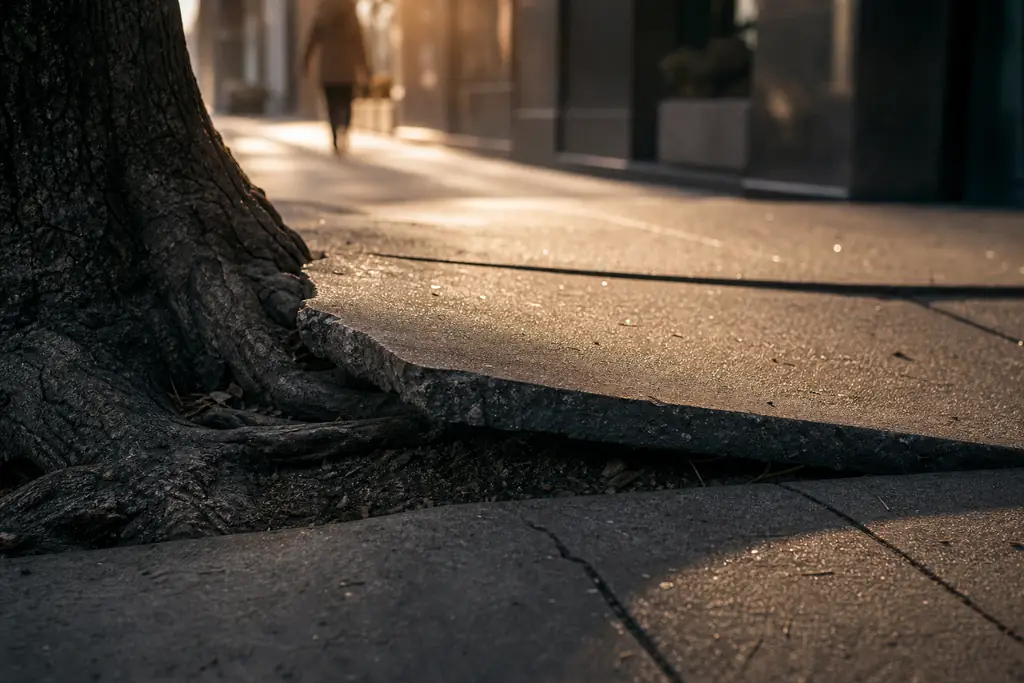
A fall on a cracked city sidewalk, in a county building, at a public park or on a transit platform is governed by the Government Claims Act, not the ordinary rules for private property. The differences are significant.
The legal standard: a "dangerous condition"
A public entity can be liable for an injury caused by a dangerous condition of its property if the condition created a reasonably foreseeable risk of the kind of injury that happened, and either an employee's negligence created the condition or the entity had actual or constructive notice of it in time to fix it (Government Code 835). A "dangerous condition" means one that creates a substantial (not minor or trivial) risk of injury when the property is used with due care (Government Code 830).
The trivial defect rule
Courts can decide that a defect was too minor to be dangerous as a matter of law (Government Code 830.2). There is no fixed height cutoff for sidewalk offsets. Courts look at the size of the defect together with the surrounding circumstances, such as lighting, weather, debris that hid the defect, and whether there were earlier accidents at the same spot. Measurements and photos taken soon after the fall, with a ruler or tape in the frame, are important.
Six months to file a claim
Before suing a public entity for personal injury, you generally must present a written claim to that entity within six months of the incident (Government Code 911.2). The claim must describe the date, place and circumstances, the injuries, and the amount claimed (or, above $10,000, whether the case would be a limited civil case) (Government Code 910).
- The entity generally has 45 days to act on the claim. If it rejects the claim in writing, the lawsuit is due within six months of that notice (Government Code 945.6).
- If you missed six months, an application to file a late claim must be made within a reasonable time, and no later than one year after the incident (Government Code 911.4).
Which agency?
Getting the right entity matters, because a claim sent to the wrong one does not protect you. In Los Angeles, a sidewalk could involve the City of Los Angeles, Los Angeles County (in unincorporated areas), another city, or a transit or school district. A private property owner next to the sidewalk may also have responsibilities: California law requires owners of lots fronting a street to maintain the adjacent sidewalk (Streets and Highways Code 5610), and local rules affect whether that creates liability to an injured pedestrian. When in doubt, claims are sometimes presented to more than one entity.
What to gather now
- Photos and measurements of the defect, with something for scale.
- The exact location: address, nearest pole or tree, and which side of the street.
- Names of witnesses, and any report made to the agency.
- Medical records showing when you first sought care.
Sources
- Government Code 835 (dangerous condition of public property)
- Government Code 830.2 (trivial defect)
- Government Code 911.2 (six-month claim)
- Government Code 945.6 (suit after rejection)
- Streets and Highways Code 5610 (sidewalk maintenance by adjacent owners)